

No—approaching snow is not, by itself, a reason to cut back hydrangeas. On some types, shortening the stems in fall can remove next year’s flower buds. Others flower on new growth and allow more pruning flexibility, but they still don’t need a pre-snow haircut.
For most healthy hydrangeas, the simplest choice is to leave living stems alone. Removing dried flowers is optional tidying, not the same as cutting back the shrub. Weather damage is a separate issue—not a reason to prune everything around it.
Whether your first snowfall is still ahead or has already arrived, use the plant’s flowering habit rather than the weather forecast to plan routine pruning. Late winter or early spring is the broadly recommended window for panicle and smooth hydrangeas. Old-wood bloomers generally need any size-control pruning just after flowering.
What Counts as “Trimming” a Hydrangea?
Before picking up the pruners, separate three different jobs:
- Deadheading means removing only a spent flower head. University of Maryland Extension describes this as removing the faded flower at the branch tip, without cutting farther down the branch. It isn’t necessary for plant health.
- Cutting back means shortening stems. This changes the shrub’s size or framework. On old-wood bloomers, those cuts may remove flower buds already in place for next season.
- Assessing damage means checking a particular bent, broken or apparently dead stem. It is not an annual whole-shrub haircut, and a branch bent beneath snow is not automatically dead.
The distinction matters most when a dried flower sits above living buds. Snipping off the flower and cutting several inches down its stem are not interchangeable decisions.
When to Prune Each Hydrangea Type
Old wood is stem growth carried over from the previous growing season. Hydrangeas that bloom on old wood form flower buds during the preceding summer or fall. New-wood bloomers form their flower buds on growth produced during the coming growing season.
That difference—not the first snow—explains most pruning advice.
| Hydrangea type | Where it flowers | What fall cutting means | Best next step |
|---|---|---|---|
| Bigleaf and mountain (H. macrophylla, H. serrata) | Usually old wood; some cultivars bloom on both old and new wood | Shortening living stems can remove next season’s flower buds. | Leave stems now. If size control is needed, generally prune just after flowering; check the cultivar before treating a rebloomer differently. |
| Oakleaf (H. quercifolia) | Old wood | Fall stem reduction can sacrifice next season’s flowers. | Leave it before snow. Schedule elective size or shape pruning just after flowering. |
| Climbing (H. anomala subsp. petiolaris) | Old wood | Fall shortening can remove flowering growth. | Usually leave it alone; shorten after flowering when necessary. |
| Panicle (H. paniculata) | New wood | Fall pruning does not remove an overwintering crop of next season’s flower buds, but it isn’t required. | Late winter or early spring is a useful default. Minnesota Extension also permits fall pruning. |
| Smooth (H. arborescens) | New wood | It does not have the same overwintering flower-bud risk as old-wood bloomers. | Wait until late winter or early spring if pruning is needed. Hard pruning is not mandatory. |
These timing recommendations follow Maryland Extension and Illinois Extension’s hydrangea pruning guidance.
There is room for regional flexibility. Minnesota Extension permits fall heading cuts on panicle hydrangeas, while recommending waiting to enjoy their winter appearance. It also advises allowing young smooth hydrangeas to establish before hard pruning and notes that leaving them unpruned produces a larger shrub.
Reblooming does not mean pruning has no consequences. Some bigleaf and mountain cultivars flower on both old and new wood. Cutting off old-wood buds can remove the earlier display and delay flowering; later pruning can interrupt or shorten reblooming. Don’t assume the plant will replace every flower you cut away.
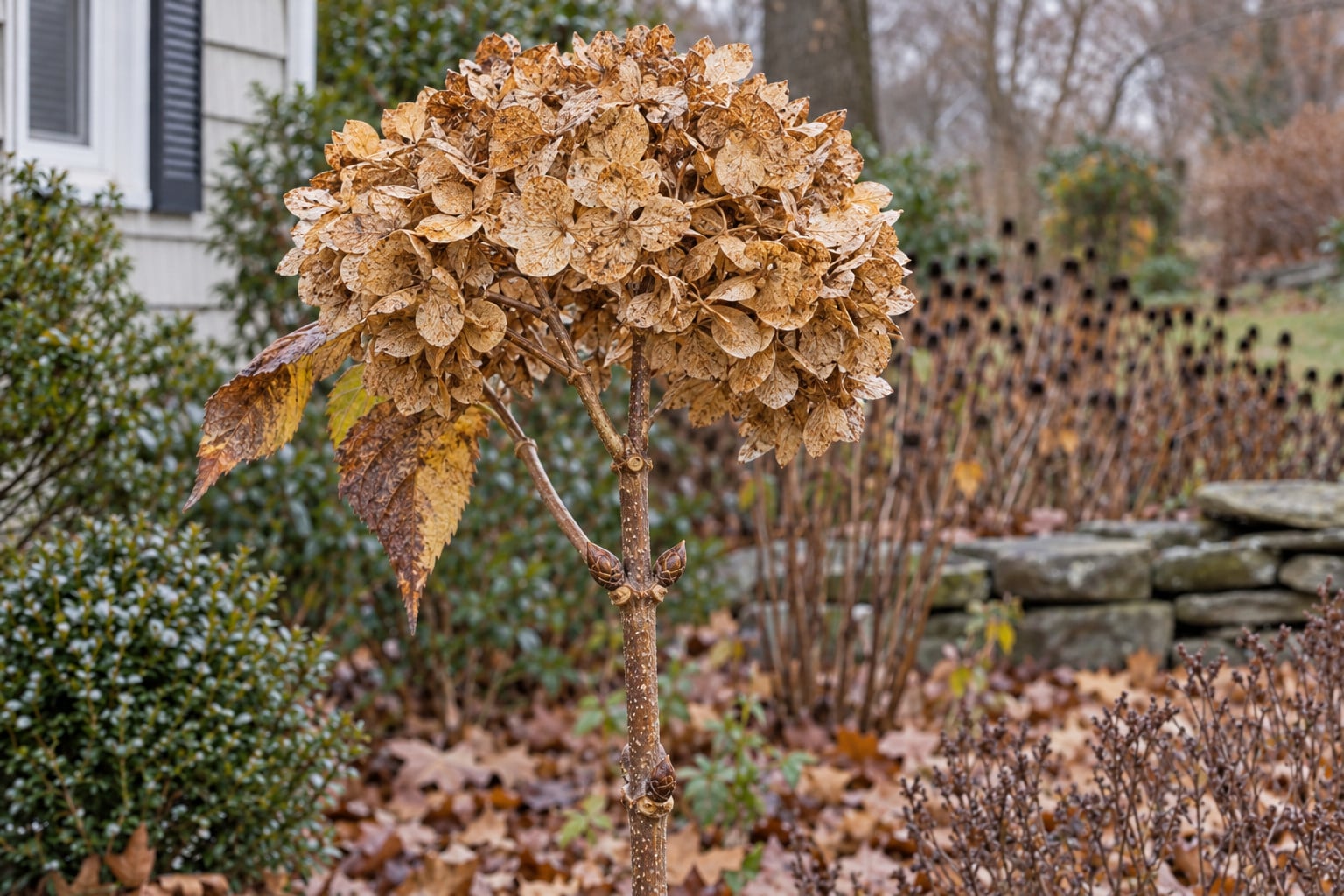
Do Dried Flower Heads Need to Come Off Before Snow?
No. You can leave them in place. Their presence is not a reason to give the shrub a fall haircut.
Although large dried heads may prompt concerns about accumulated snow, the pruning sources cited here do not establish that removing them prevents or measurably reduces winter damage. Treat flower removal as an appearance choice, not storm protection.
There is also a reason to leave faded mophead flowers intact. The UK’s Royal Horticultural Society recommends retaining them over winter to provide some frost protection for the growth buds beneath them, while allowing earlier removal in mild areas. That advice concerns frost—not protection from snow weight or ice. In colder or exposed locations, leaving those heads until spring is the conservative choice.
If you prefer a tidier plant, keep the job to the spent flower itself, rather than following its stalk down into the leafy or bud-bearing stem. This flower-only distinction applies across the groups in the table; it is not an instruction to shorten every flowered stem to a particular pair of buds. If you cannot clearly separate the faded head from the living stem, leave it until you can make a type-appropriate pruning decision.
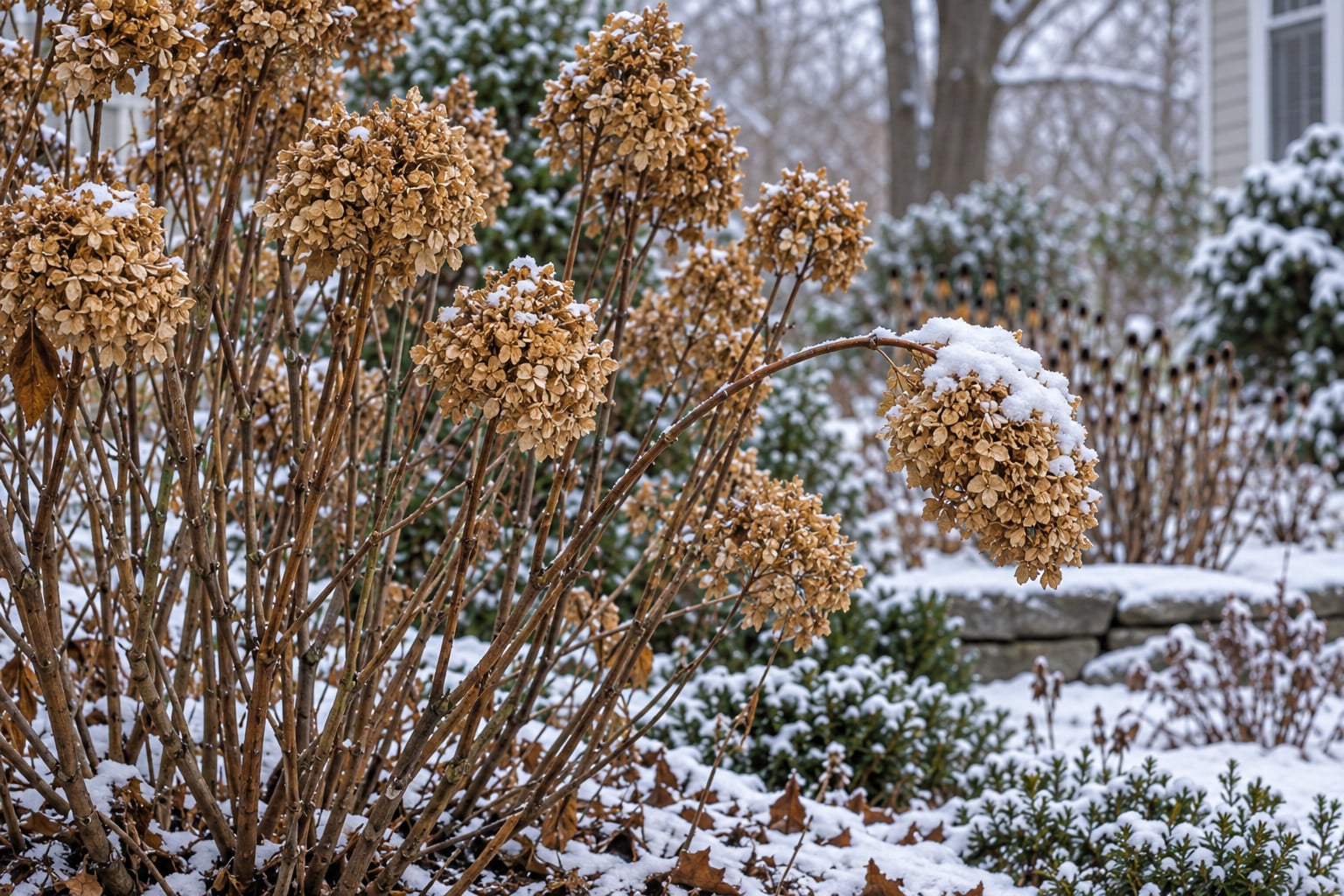
Assess Weather Damage Separately From Routine Pruning
A stem leaning under snow has not necessarily died, and its temporary position is not a useful guide for reshaping the shrub.
For snow-covered stems, postpone elective shaping and reassess after the load has cleared. This is an observation step, not a promise that every branch will spring back.
For ice-covered growth, wait for thawing before elective work. Don’t try to force a frozen stem back into position.
Once snow and ice have cleared and you can inspect the shrub safely, distinguish stems that are merely bent from those with visible cracks or breaks. Do not cut a stem simply because it is bent. A physical break is a separate repair problem; the flowering-based timing table above is not a guide to repair cuts.
For a large split, a damaged climbing support or a branch threatening a walkway, get situation-specific help rather than attempting routine home pruning.
Uncertain winter dieback is different from a visible break. If you are unsure whether an intact stem tip survived winter, wait for spring growth to clarify what is alive. Maryland Extension recommends assessing winter dieback as growth resumes.
For frost-damaged shoots in spring, the RHS pruning guide recommends cutting back to just above the first undamaged pair of buds on healthy wood. This is UK guidance for frost injury, not a universal US pruning date or a repair instruction for cracked and broken stems.
Your Before-Snow Hydrangea Checklist
- Decide whether anything actually needs doing. Healthy stems and faded flowers alone do not call for a cutback.
- Leave old-wood bloomers standing. Save elective size reduction for just after flowering, rather than treating snowfall as a deadline.
- Keep optional tidying small. Remove only the spent head if that boundary is clear; otherwise, leave it. Retaining mophead flowers is especially reasonable where frost protection matters.
- Schedule new-wood pruning for later. Put panicle and smooth hydrangeas on a late-winter or early-spring reminder if they need pruning. There is no single cut height suitable for every plant.
- Preserve a tree-form panicle’s trunk. Do not apply a low shrub cutback to a hydrangea trained as a small tree.
- Separate weather damage from routine pruning. Inspect safely after snow or ice clears, and let spring growth reveal uncertain dieback on intact stems. Neither a bent stem nor a visible break calls for a whole-shrub haircut.
Not sure which hydrangea you have? Leave its living stems for now. Check the plant label, purchase record or previous flower photographs before planning size reduction. You can also browse Planet Natural’s hydrangea care articles as you narrow down the type.
Waiting preserves the possibility of old-wood flowers without committing you to a complicated fall project. For a healthy hydrangea, the first snow can simply be a change of scenery—not a pruning deadline.


