

The pumpkin is open. There’s a bowl of seeds on the counter and room for only a few vines next summer. Save them, or order a packet?
Save them if you have room for a labeled experiment. Choose fresh, identified seed if you need a particular pumpkin. Getting a seed to sprout and getting the harvest you wanted are two different jobs.
Before you start rinsing, check what you know about the pumpkin—and what you’re asking its seeds to do.
What do you actually know about this pumpkin?
Start with its source. Did you grow it, buy it from a grower who knows the variety, or bring it home from a display bin? Write down any stated variety name and whether it was identified as a hybrid. Leave missing information marked “unknown.”
A named variety is useful information. It is not a pollination record. Neither is a familiar orange shape.
As Illinois Extension explains, a purchased pumpkin may come with little information about how it was grown. Its appearance cannot tell you which plant supplied the pollen.
Here’s the distinction that matters:
- Viable seed can germinate.
- True-to-type seed produces plants with the expected characteristics of the variety.
One does not prove the other. According to SDSU Extension, pollen from a compatible plant can affect the next generation grown from saved seed, not the shape or flesh of the pumpkin already on your counter.
Compatibility matters. Don’t assume every nearby pumpkin, squash, cucumber, or melon could have crossed with it. But without reliable growing and pollination records, don’t assume the offspring will match it, either. Record known hybrid status without treating it as a prediction of exactly what the saved seed will produce.
The keep-or-skip worksheet
Use this before committing drying space—or next summer’s garden space.
| Ask yourself | Save as an experiment | Choose fresh, identified seed |
|---|---|---|
| What harvest do I want? | Different shapes or other unexpected traits are acceptable. | I want a particular cooking pumpkin, size, or variety. |
| What do I know about its history? | I can record the source and leave parentage unknown. | I need repeatability but have no reliable pollination history. |
| Is the pumpkin suitable? | It is mature and sound, with no known disease in the parent plant. | It is immature, rotting, moldy, or otherwise doubtful. |
| Can I finish the job? | I have a cool, dry place to spread the seeds for several weeks. | I have nowhere suitable to dry and store them. |
| Can I spare the growing space? | An experimental vine fits the plan. | Every planting space needs to serve the intended harvest. |
Skip seed from a plant known to be diseased. For a purchased pumpkin, you may not know the plant’s health. Sound appearance is a useful starting point, not proof that seed is disease-free.
Passing over a deteriorating display pumpkin is a conservative choice, not a declaration that every seed inside is dead. There is no useful universal cutoff here for days on the porch, frost exposure, or time since carving. If the material leaves you doubtful, start with something better.
And if you already have a suitable mature pumpkin, process it now. There’s no seed-saving reason to hold it until Thanksgiving.
Decide what to do with this batch
Decide what you want from your main planting first. If you want to try the saved seeds, work through these checks in order and stop at the first reason to skip.
-
Plan the main harvest
If you need a particular variety, size, or kind of cooking pumpkin, choose fresh, identified seed for the main planting. Continue only if you also want a separate saved-seed trial.
-
Check the pumpkin
If the pumpkin is immature, rotting, moldy, or otherwise doubtful, or if the parent plant was known to be diseased, skip this batch. That’s a conservative planting decision, not proof that every seed is dead.
-
Check your drying, storage, and garden space
If you lack a cool, dry place to spread the seeds for several weeks, suitable dry storage, or room for an experimental vine, skip the batch. Use fresh, identified seed for the planting space you have.
-
Decide whether an experiment suits you
If you can’t accept unexpected traits or can’t keep the batch clearly labeled as an experiment, skip it and choose fresh, identified seed. Missing records alone aren’t a reason to skip.
-
Save the batch as an experiment
If the pumpkin is mature and sound, there’s no known parent-plant disease, and the space and uncertainty work for you, clean and air-dry the seeds completely. Label them as an experiment, store them in a paper envelope somewhere cool, dark, and dry, and recheck the batch and garden space before sowing.
Missing history
Record what you know. Mark missing variety, hybrid, or pollination information “unknown” and parent-plant health “not observed” if you didn’t see the plant. Neither the fruit’s appearance nor a stated variety name verifies parentage.

If you keep them, clean and dry them properly
N.C. Cooperative Extension’s pumpkin-seed guidance emphasizes mature seed, careful drying, and dry storage. Keep the process simple:
- Scoop out the seeds. Separate them from the stringy pulp. Set aside broken or visibly damaged seeds rather than counting on them for planting.
- Rinse in a colander. Remove the remaining pulp with water and let the seeds drain.
- Spread on a screen. Arrange them evenly in a cool, dry place. Turn or stir them during the first two days so they don’t remain stuck together.
- Allow several weeks for air-drying. Do not package until completely dry. N.C. Extension specifies at least three weeks; Illinois describes about a month. Those are planning guides, not a guarantee that seeds are ready on a particular date.
- Envelope, label, and store. Put fully dry seed in a paper envelope and keep it somewhere cool, dark, and dry.
These are planting seeds. Keep them separate from any batch being seasoned or roasted for eating. A closed bag is storage, not a drying plan.
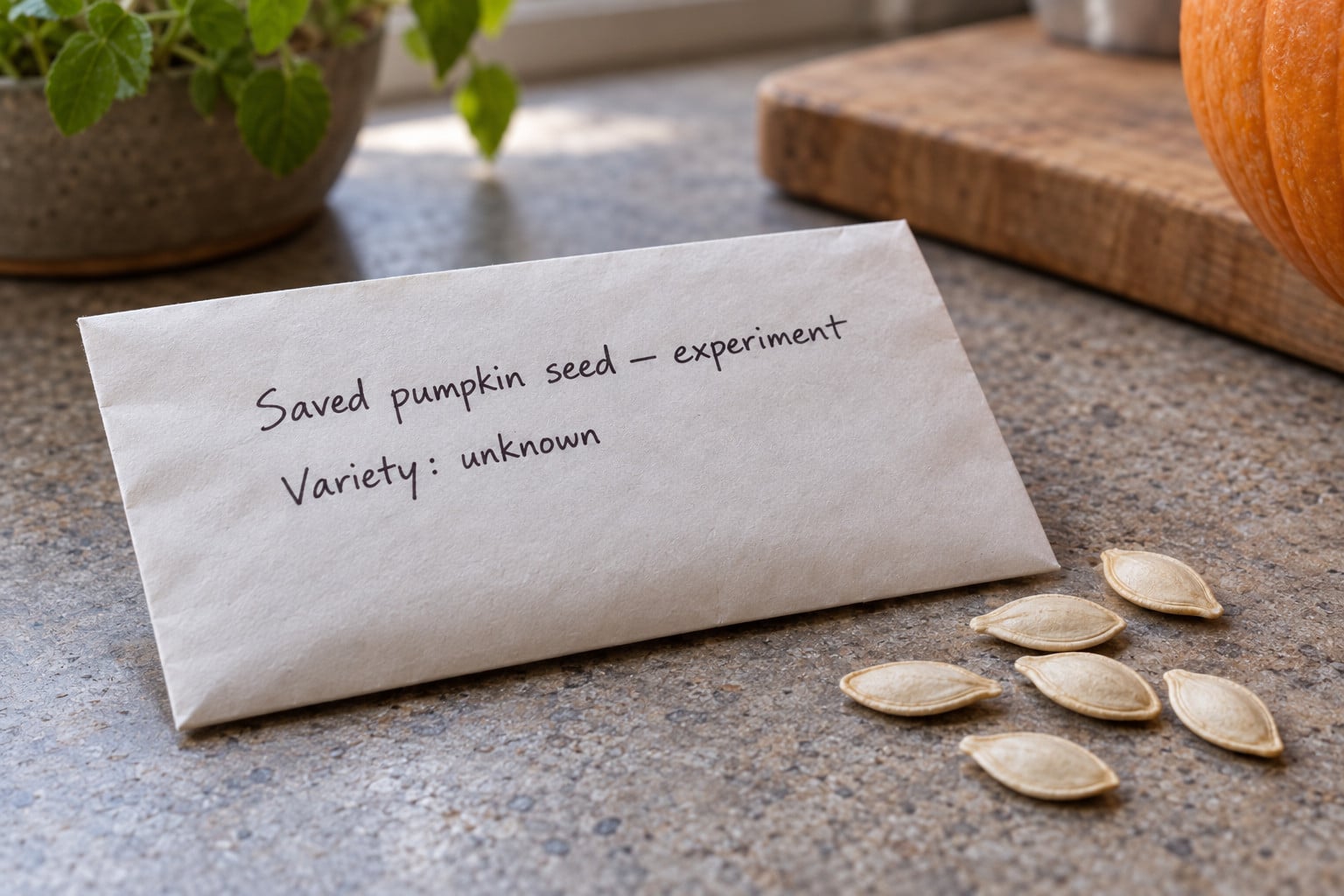
Give uncertainty its own line on the label
In 2011, my sister Elena asked what was in an incompletely labeled seed envelope. I added the year and variety where I knew them. One anonymous envelope stayed anonymous. A guess did not need a permanent label.
Use that same rule for the pumpkin. Copy this onto the envelope:
Saved pumpkin seed — experiment
Fruit source: __________
Collection date: __________
Variety stated by grower or retailer: __________ / unknown
Hybrid status: __________ / unknown
Parent-plant health: __________ / not observed
Pollination history: __________ / unknown
Parentage not verified; offspring may differ.
Record a retailer’s variety name as a stated name. Don’t supply one from a photograph or a resemblance. If you’re also saving beans for seed, keep each crop in its own labeled batch.
Keep next year’s fruit safety separate
An experimental planting is not a guaranteed food crop. Attractive fruit and successful germination do not establish that future squash is safe to eat.
Do not deliberately taste unfamiliar squash to check its safety. If unusual bitterness is encountered while eating squash, stop eating it, discard the fruit, and remove the plant rather than harvesting more from it. That discard-and-remove advice comes from SDSU Extension’s bitter-squash warning.
Make the decision again in spring
Saving the seed does not commit you to planting it.
Before sowing season, review the label, inspect the stored seed for deterioration, and count the space you can actually spare. Does an uncertain harvest still sound worthwhile?
If you sow saved seed, keep it clearly identified and separate from purchased seed. Watch whether it germinates, but remember what that tells you: the seed can grow. It does not verify its variety or future fruit safety.
For a planned harvest, make fresh, identified seed the main planting. Give the saved seed space only if the experiment still fits. The envelope takes up very little room. The vine is another matter.


