

What will this tree occupy when it is grown?
A young tree may look right beside the patio. The better test is whether its mature crown can shade the chairs without crowding the roof. If you’re planting for privacy, stand where the view bothers you. Will the foliage block that view in winter without narrowing the walkway? Sketch the space first. Then use it to rule out poor shade-tree fits and compare two evergreen screening candidates.
Sketch your site before you shop
- Give the tree one main job. For shade, mark the spot you want shaded and when you use it. For privacy, mark the view you want to block and how high the foliage needs to reach. Note whether you need cover through winter.
- Measure from the proposed trunk. Mark the house, fence, pavement, gates and paths on a rough sketch. Measure from the proposed trunk to the nearest obstacle in each direction. For a screen, measure the space on both sides of the proposed row, not just its length.
- Sketch the mature crown. For a first pass, draw the crown centered on the trunk. Use half the upper end of the reported mature width as the distance from the trunk to the crown edge. If a tree is listed at 30–40 feet wide, sketch it reaching about 20 feet from the trunk. If the garage is 15 feet away, the sketch shows a conflict even before you leave room for access. Move the trunk location or look for a narrower tree. This is an example, not a setback rule.
- Leave room for an uneven crown. Trees don’t always spread evenly, and the upper end of a published range isn’t a guarantee. If the fit is close, check how wide the exact species or cultivar grows locally, or choose a tree with more room to spare.
- Check what the sketch can’t show. Note overhead lines, how much sun the spot gets, where water lingers after rain and whether you can water during dry spells. The sketched crown edge isn’t a root boundary or a utility clearance. Use King County’s tree siting guidance to spot potential conflicts, follow your utility’s clearance rules and contact your local utility-locating service before digging. A USDA hardiness zone helps you judge winter cold, not summer heat, drainage or water needs.
What “fast-growing” actually tells you
Ask what the nursery’s growth estimate measures. Is it the length of new shoots, a gain in overall height or a comparison with other trees? Ask whether it applies to an established tree and what growing conditions it assumes. Purdue Extension’s northern Indiana guidance, for example, describes some trees as fast relative to others in that region. That’s a comparison, not a timetable for your yard.
Growth rate, establishment and time to useful shade or privacy are different things. A tree can gain height without spreading far enough to shade the patio. A tall evergreen can still leave a gap at window level. Compare speed only after the mature tree passes your site checks.
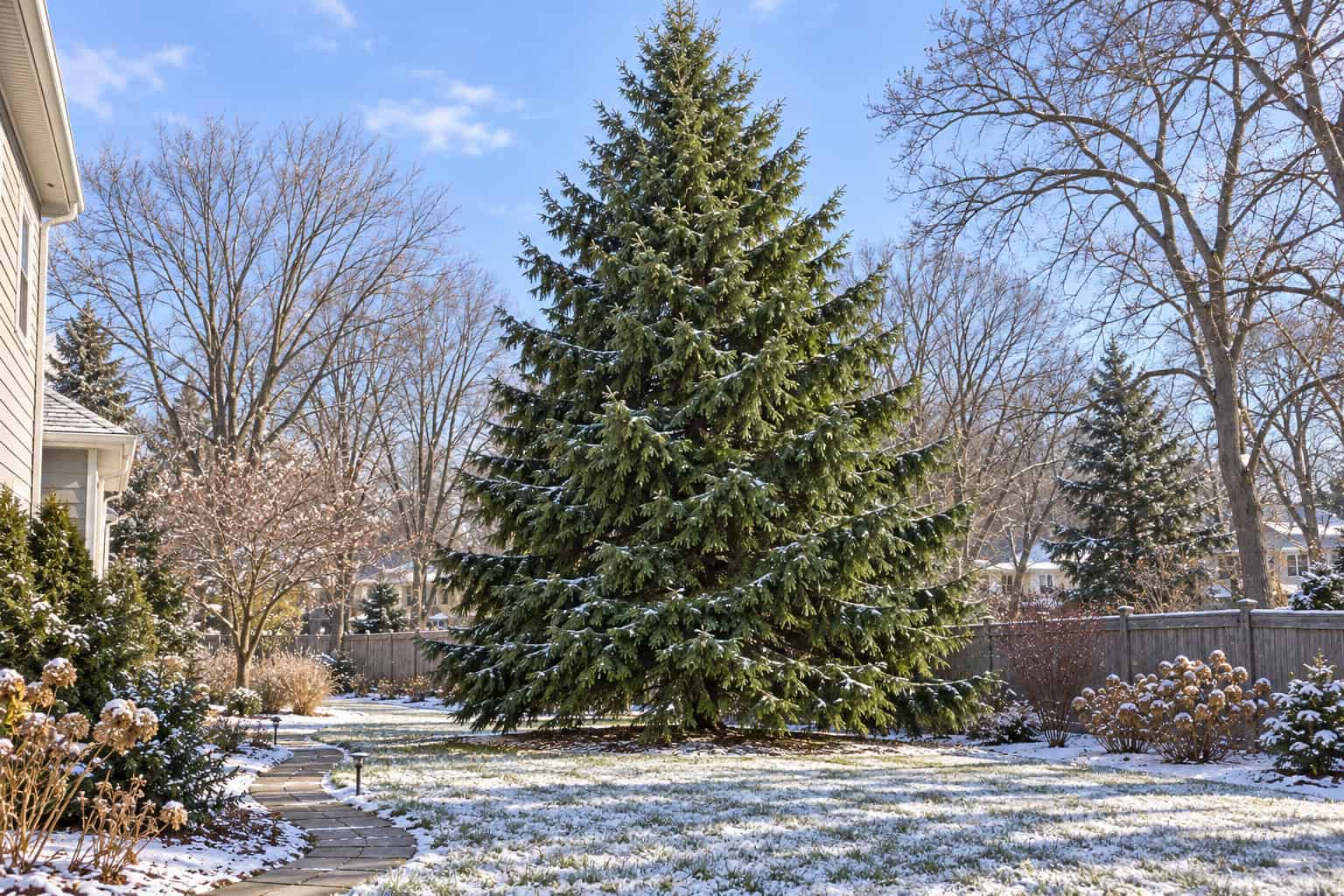
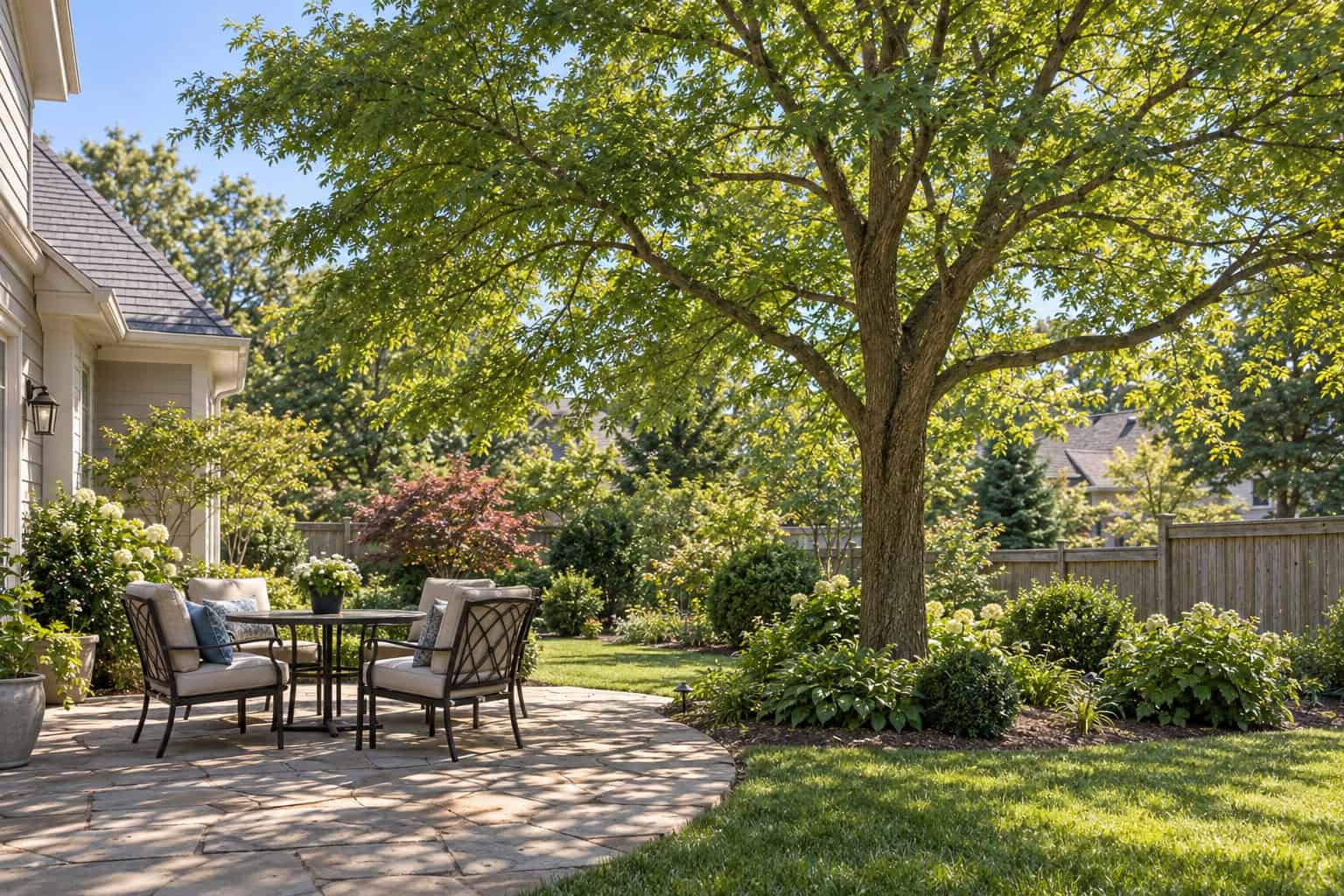
Shade or privacy: Compare the fit before the speed
| Job | What to compare | When to rule it out |
|---|---|---|
| Shade a patio or seating area | Compare mature height and crown width with the space around the trunk. Check where the crown would sit relative to the patio and the sun when you use it. | The crown is likely to crowd a roof or passage, or the tree’s height conflicts with overhead lines. |
| Block a view year-round | Check whether foliage will fill the sightline. Compare unpruned width across the row with the room on both sides. Measure trunk spacing along the row separately. | The foliage won’t cover the view in winter, or the row would squeeze a path, gate or fence access. |
For shade, check where the shadow will fall
A crown that fits on your sketch won’t necessarily shade the chairs. Go outside when you normally use the patio and note which direction the sun comes from. On your sketch, mark the side of the seating area the sunlight comes from. Start looking for a trunk location on that side, then check whether there’s room for the mature crown there.
Keep a tree on your shortlist if its mature crown fits and is likely to shade the spot when you use it. If you want filtered light rather than deep shade, ask where you can see a mature example; a young tree in a pot won’t show you what the mature canopy is like. Check that the exact species or cultivar can handle your winter cold, soil, drainage and summer watering limits.
Set it aside if you can’t find a reliable mature spread. A height estimate won’t tell you whether the crown can reach the patio without crowding the house.
For evergreen screening, measure across the row
Ask for three separate figures: unpruned mature width, expected width if regularly trimmed and spacing between trunks. Trunk spacing tells you how trees are arranged along the row, not how far foliage will extend toward the path or fence. The widths below are planning figures for full-grown trees, not maximum sizes, clipped hedge widths or planting intervals.
| Candidate | Suitable site | Reported mature height × width | Growth | Main limitation |
|---|---|---|---|---|
| ‘Green Giant’ arborvitae (Thuja ‘Green Giant’) | Moist, well-drained soil with sun or light afternoon shade. NC State Extension lists USDA zones 5a–8b. | 40–60 feet tall × 12–18 feet wide | Rapid in NC State Extension’s cultivar profile; not a timeline to privacy. | Poor drainage raises the risk of root rot. Avoid sites exposed to salt spray or salty soil. |
| Norway spruce (Picea abies) | Full sun in a Minnesota yard with room for a large evergreen. University of Minnesota Extension lists it for Zone 2. | 80 feet tall × 30 feet wide | Medium to fast in the Minnesota guide, not an annual rate. | The crown takes up substantial room across a row. |
‘Green Giant’ arborvitae
Choose it if you need dense, year-round screening and can fit both the height and the width. At the upper end of NC State Extension’s range, an 18-foot crown reaches about 9 feet to either side of the trunk on a centered sketch. That’s before you leave room to open a gate or walk behind the row.
Skip it if the site stays soggy, is exposed to salt or would fit the tree only with frequent clipping. The listed hardiness range is a guide to winter cold, not proof that ‘Green Giant’ will suit a hot or dry site.
Norway spruce
Choose it for further comparison if you have a sunny, roomy Minnesota site. On a first-pass sketch, a centered crown 30 feet wide reaches about 15 feet to either side of the trunk. Check whether the foliage will cover the view you marked while leaving room to use paths and gates. The Minnesota guide’s Zone 2 listing isn’t a full hardiness range or a guide to summer heat tolerance elsewhere.
Skip it if that footprint would crowd a path, fence or structure. A naturally narrower selection or, where permitted, a fence or trellis may block the same view in less space.
Familiar fast growers to approach with care
- Callery pear, including Cleveland Select: Arkansas Extension reports that Cleveland pear can fruit and that Callery pear seedlings were spreading in Arkansas. Choose another tree. An invasive-plant listing isn’t the same as a sales restriction; check your state’s current rules separately.
- Japanese angelica tree and black bamboo: Don’t put Japanese angelica tree (Aralia elata) or black bamboo (Phyllostachys nigra) on your shopping list without checking regional invasive-plant guidance and applicable rules. Black bamboo is a grass, not a tree.
- Willows, poplars and silver maple: K-State Extension advises against these for Kansas City suburban landscapes. Arkansas Extension also notes surface roots and limb shedding with silver maple. These are reasons to ask about local performance, not a blanket rule for every willow or poplar.
- Freeman maple and Autumn Blaze: Freeman maple is the red maple–silver maple hybrid; Autumn Blaze is a selection of that hybrid. If one tag says only “Freeman maple” and another says “Autumn Blaze,” ask for the full cultivar names before counting them as different options. Purdue discusses Freeman maples as an option for northern Indiana, while K-State advises against them in the Kansas City area.
- Tropical and warm-climate choices: Royal poinciana, koa, rainbow eucalyptus and Mexican fan palm aren’t substitutes for temperate-yard trees. If you’re considering one, start with guidance for your climate.
Take these questions to the nursery
Bring your sketch and a photo of the planting space. Write down the answers for each candidate so you can compare them at home.
- What are the exact species and cultivar on the tag?
- What mature height and width should I plan for here without clipping? For a screen, record maintained width and trunk spacing separately.
- What does your growth estimate measure, and under what conditions?
- How does this tree handle my winter cold, summer heat, drainage, soil pH and watering limits? What problems do you see locally?
- Can you show me the root flare and point out any damaged branches or competing stems? It’s easier to check these before you bring the tree home.
If nothing fits without guesswork or constant pruning, widen your search to include slower-growing trees.
Plant at the right depth and check before you water
These planting and early care checks follow University of Maryland Extension’s tree and shrub planting guidance.
- Find the root flare before you dig. Gently brush excess soil from the trunk base until you see where the main roots begin to spread. Measure from that point to the bottom of the root ball to judge how deep to dig. Set the flare at the surrounding soil level and leave it visible after backfilling and mulching.
- Check the root ball, not just the surface. Pull mulch aside and feel the soil several inches down in the root ball and in the surrounding soil. If the root ball is drying at that depth, it’s time to water. Don’t add water just because the surface looks dry or a calendar says it’s time. Check how wet the surrounding soil is so you don’t keep it saturated.
- Look at branch structure at planting and again as the tree grows. Check for damage and for competing upright stems on a tree meant to have one main trunk. Skip routine canopy pruning at planting. Limit cuts to damaged branches or necessary structural corrections, and don’t cut back healthy top growth to make up for transplanting.


